Starlink vs 4G/5G Rural Home Broadband UK: Speeds, Latency & Gale-Proof Mounting
Starlink vs 4G/5G Rural Home Broadband UK: Speeds, Latency & Gale-Proof Mounting
Written and physically verified by Gary Pearce, Lead Telecom & Physical Infrastructure Engineer at ADI Communications (25+ Years Hands-On Field Experience, £10 Million Public Liability Insurance). Independent engineering advice for Yorkshire and North England property owners.
For rural properties across Yorkshire with sub-15 Mbps landline speeds, SpaceX Starlink Gen 3 delivers consistently higher download throughput (180–280 Mbps) and lower jitter than 4G/5G mobile broadband. While high-gain 4G/5G antenna installations cost less upfront, mobile mast cell contention during evening peak hours severely degrades video calls and streaming. Both systems require heavy-duty galvanised Pennine storm brackets or non-drill chimney lashing cradles to survive 90mph winter gales.
(Note: Gary Pearce and ADI Communications are fitted with CAI-benchmarked equipment and double-screened WF100 cable, but are not members of the CAI).
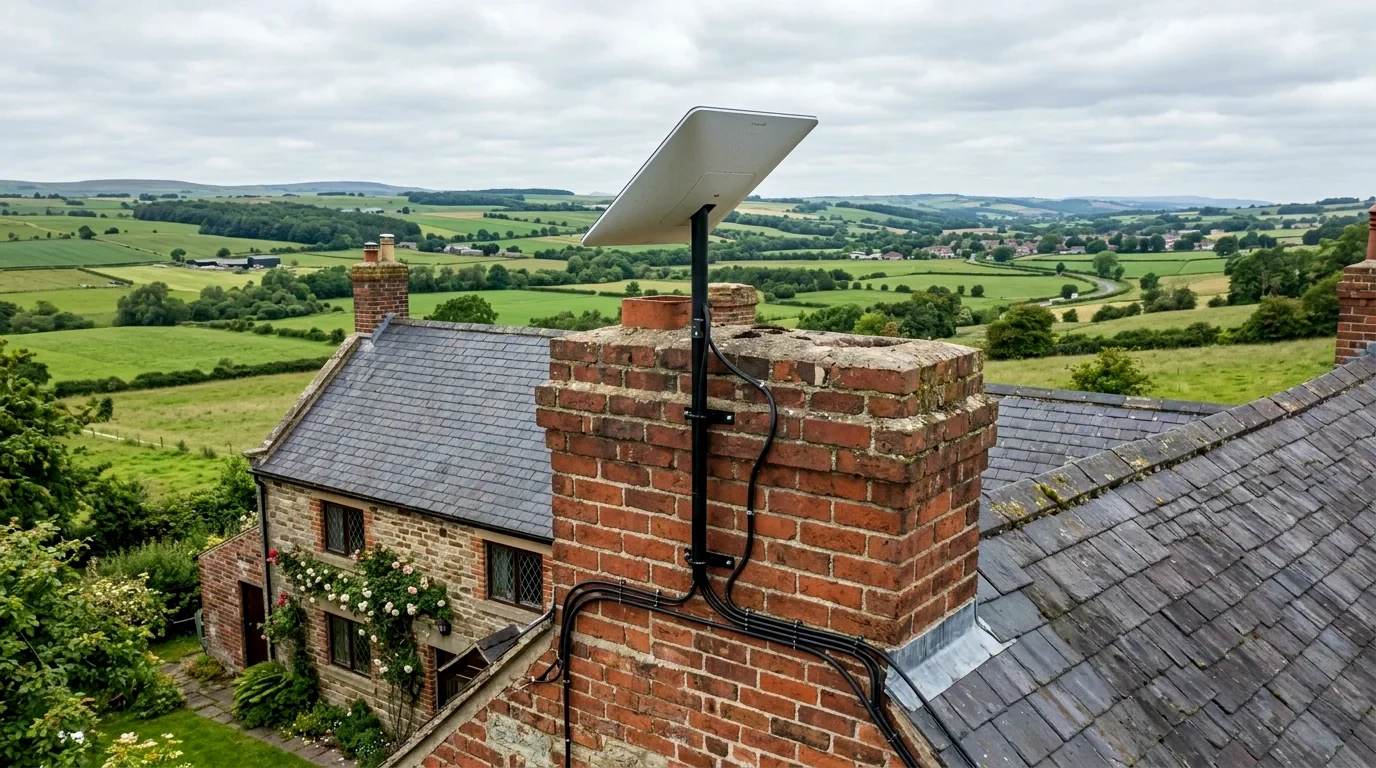
1. The Rural Connectivity Dilemma: Satellite vs Cellular Antennas
Living in rural Yorkshire, the Peak District, or remote Pennine valleys often means being left behind by traditional Openreach FTTC copper lines that degrade over kilometres of overhead telegraph wire. When landline speeds drop below 10 Mbps, homeowners and business operators are left with two primary wireless options: Low Earth Orbit (LEO) satellite internet via SpaceX Starlink, or directional external 4G/5G mobile broadband antennas aligned to distant cellular masts.
After 25 years installing telecommunications and satellite equipment across Northern England, I evaluate these options based on physical reality, weather resilience, and actual throughput under peak evening loads. While 4G/5G mobile routers with external Poynting cross-polarised antennas can provide a serviceable budget fix in areas with clear line-of-sight to an uncongested mast, they are fundamentally vulnerable to seasonal atmospheric fading, tree foliage growth, and heavy evening network contention from hundreds of smartphones connecting to the same rural cellular sector.
Starlink bypasses terrestrial mast bottlenecks entirely by communicating directly with thousands of low-orbit satellites traveling at 17,500 miles per hour 340 miles above the Earth. However, satellite internet requires an unyielding physical installation. An improperly secured flat-panel dish buffeted by cyclic gale-force wind shear will suffer intermittent packet dropouts, while poor cable ingress through historic Yorkshire masonry will cause internal plaster damp and water tracking into your router core.

2. Structural Mounting & Cable Integrity in 90mph Gales
Whether you choose satellite or cellular, the weak link in rural broadband is almost always the physical mount. Standard manufacturer mounting kits supplied in the cardboard retail box are designed for calm suburban American timber-frame homes. They are completely inadequate for exposed Yorkshire stone chimney stacks or steep slate roof pitches subjected to cyclic gale-force buffeting.
On older properties, we never drill directly into weathered chimney brick courses or lime mortar. Drilling expansion bolts into historic chimney stacks fractures the mortar bonds, loosens chimney pots, and creates dangerous structural weakness. Instead, we deploy commercial CAI-standard stainless steel chimney lashing kits with corner mitre protectors. High-tensile stainless steel wire is tensioned around the stack using dual J-bolts, clamping a heavy-duty wide-stance alloy mast securely without boring a single hole in the masonry.
Cabling integrity is equally paramount. We run pure solid-copper 23AWG Cat6 data cable with a black UV-resistant polyethylene (PE) exterior sheath. Standard white or grey indoor PVC cables crack within two UK winters when exposed to sunlight and freezing rain. All external cable penetrations feature downward drip loops beneath the masonry sill line and weatherproof silicone injection grommets, ensuring complete damp-proof isolation.
3. Frequently Asked Trade Questions (Direct Field Answers)
Speak Directly With Lead Engineer Gary Pearce
No subcontractors, no call centres. Get realistic, honest trade advice on your property's physical installation.
Call Direct: 07860 244 274

Comments
Post a Comment